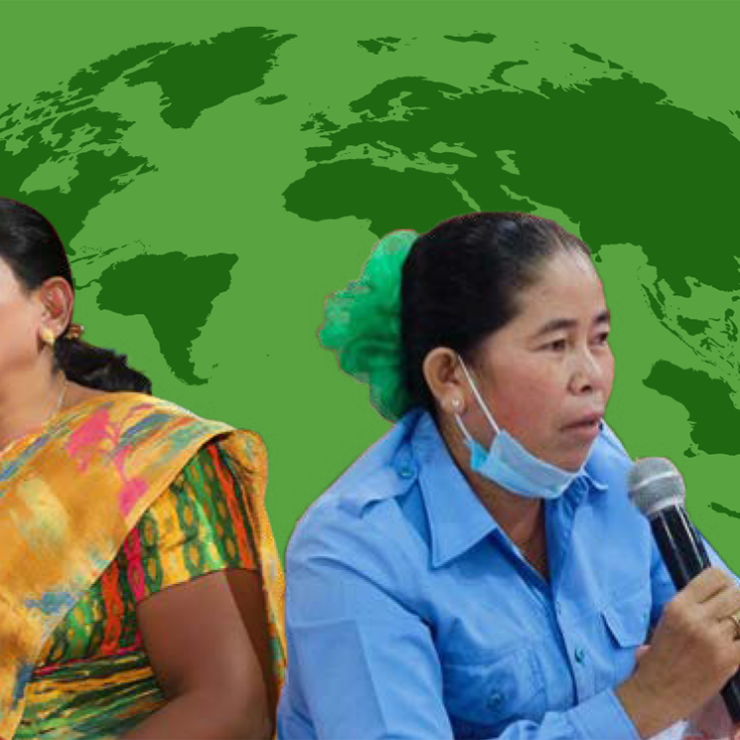
Discover PMI-WILL's first Impact Report
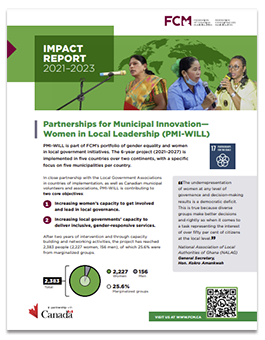 We are pleased to share the first PMI-WILL Impact Report, which documents how the program is transforming the communities and people where it works. The report showcases the progress achieved in the first two years of implementation, in particular how it is enhancing women's role in local government and inclusivity of municipal services. Through dynamic capacity building and networking initiatives which engaged our Canadian municipal partners, the project has reached a diverse group of more than 2000 women. Notably, 26% of participants hailed from marginalized groups, underlining our commitment to equity and inclusion. More specifically, PMI-WILL contributed to:
Empowering Women in Local Governance: By providing capacity building and networking activities, and by uplifting women's participation and leadership in local governance. The report provides examples of women candidates who received training and support, paving the way for greater representation and participation in local elections.
Policy Changes for Greater Inclusion: PMI-WILL advocated for policy changes to ensure a more inclusive and gender-responsive approach in local governments. Read how policy shifts made a tangible difference.
Inclusive Municipal Services: By supporting efforts and collaboration to foster gender-responsive municipal services, which benefits the entire community. Learn about innovative approaches that promoted inclusivity.
Global Collaboration: PMI-WILL promotes and supports international collaboration to drive positive change. Discover how peers coming together made a global impact.
The full report is available here.
June 2023
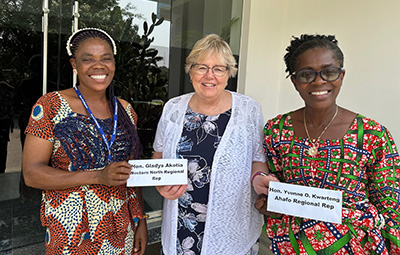 The PMI-WILL is able to reach its objectives thanks to FCM members who offer their time and expertise to support their peers overseas, including women elected officials, local governments, and their associations. With the second year of the project concluded, here is a snapshot of the involvement of Canadian municipal experts and elected officials in the project.
After being limited to virtual exchanges last year, the first overseas missions were launched in 2023. Two Canadian councillors had the opportunity to exchange with their counterparts: Councillor Kathy Jeffery from Collingwood, ON, supported the District Women’s Caucus of the National Association of Local Authorities of Ghana (NALAG), and Councillor Anik Des Marais from Gatineau, QC, met with women elected officials of the National League of Communes of the Kingdom of Cambodia (NLC). Councillor Jeffery provided training on developing a strategic plan to increase the number of women in local leadership through advocacy and communication, while Councillor Des Marais provided a training on roles and responsibilities.
Thanks to the involvement of representatives from Canadian Provincial and Territorial Associations of Municipalities, in person peer-to-peer exchanges and trainings were possible in Benin, Cambodia, and Ghana. As a result, the Benin National Association of Municipalities (Association nationale de communes du Bénin) drew up a catalogue of potential services to generate internal revenue via services provided to their members. NALAG received training on best practices for gender mainstreaming, inclusion and advocacy which will inform their strategic plan. In Cambodia, as part of efforts to develop capacity on gender equality and social inclusion for the NLC board and staff, particularly for newly elected board members, NLC participated in a training session on gender and advocacy. In parallel, virtual exchanges continue with the Local Government Association of Zambia (LGAZ) on sustainable revenue generation to strengthen LGAZ financially. We look forward to in person exchanges in Zambia in year 3!
Why PMI-WILL?
Local governments are responsible for a wide range of services that are essential to people’s daily lives. Many of the services deemed local in nature (sanitation, water provision, primary education, community health services, local transportation) impact women and girls the most. Local governments play a key role in ensuring equitable access to those services.
But municipal plans and services, such as infrastructure and security, often do not take patterns of women's movement and places of work into consideration, exposing them to increased risks to their health and safety, including gender-based violence.
Working to achieve gender parity on municipal counciIs and developing inclusive processes to assess citizens’ needs are proven measures that FCM has implemented in various settings and locations to tackle socio-economic disparities, help redress democratic deficits and improve gender equality. Along with our Canadian municipal experts, we are applying this peer-to-peer approach with partners in five countries in Africa and Asia.
The Partnerships for Municipal Innovation – Women in Local Leadership (PMI-WILL) is a six-year project (2021-2027) that is part of FCM’s portfolio of gender equality and women in local government initiatives. It is implemented in five countries: Benin, Cambodia, Ghana, Sri Lanka and Zambia.
The project is funded by Global Affairs Canada. It helps to achieve the goals of Canada's Feminist International Assistance Policy (FIAP) by assisting “governments of developing countries to improve their ability to deliver programs that support gender equality at all levels of government and in all sectors.” By “supporting civic participation among groups disproportionately affected by poverty” it is also aligned with Canada’s Official Development Assistance Accountability Act (ODAAA).
PMI-WILL aims to achieve two core objectives:
- Increasing women’s capacity to get involved and lead in local governance
- Increasing local governments' capacity to deliver inclusive, gender-responsive services
PMI-WILL is implemented in partnership with FCM’s member municipalities, provincial and territorial associations (PTAs), as well as in collaboration with Local Government Associations (LGAs) and key stakeholders in each of the five implementation countries. It is funded by the federal government through Global Affairs Canada.
We thank all the elected officials, the municipalities and the Provincial and Territorial Associations involved in the project for their ongoing support.